Although many consider the Feast day of Our Lady of Czestochowa, patroness of our postabortive work, August 26th, Pope Pius XI designated May 3rd as the feast day of Our Lady of Częstochowa.
Our Lady of Czestochowa pray for us!
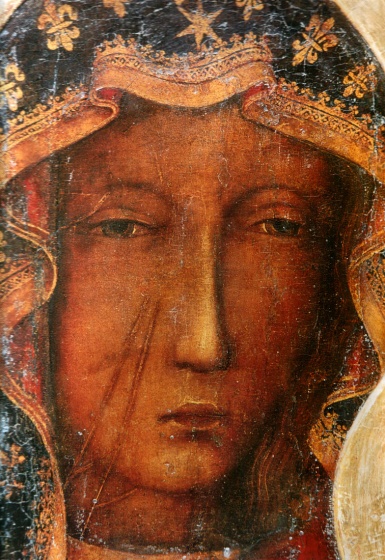
Our Lady of Czestochowa

The image of Our Lady of Częstochowa, also known as the Black
Madonna, was traditionally believed to have been painted by St. Luke the
Evangelist on a cypress wood panel from a table used by the Holy Family
in Nazareth. It was said to have been brought from Jerusalem by St.
Helen and was enshrined in Constantinople for 500 years. It was given
to a Greek princess married to a Ruthenian nobleman and it was housed in
the royal palace at Belz in the Ukraine for the next 600 years. Art
historians believe it is a Byzantine icon of the Hodigitria type dating from the 6th – 9th Century.
The image was brought to Poland in 1382 by Ladislaus of Opole who rescued the painting from Belz while escaping an attack by the Tartars who had damaged the painting
with an arrow. On his way to Silesia, Ladislaus stopped to rest in the
town of Czestochowa near the church on Jasna Góra (Bright Hill). He
believed that it was Our Lady’s desire for her image to remain in
Czestochowa so he left the image at the church and invited the Pauline
monks from Hungary to be its guardians.
On April 14, 1430, robbers, sometimes associated with the Hussites of
Bohemia, looted the monastery and made three slashes on the face of Our
Lady in an attempt to remove valuable stones, finally smashing the
image into three pieces. In order to repair the icon, the original
paint was removed and the icon was repainted. Although the icon was
restored, the slashes in Our Lady’s face remain visible today.
The image of Our Lady of Częstochowa is associated with several
miraculous events. One of the most spectacular occurred in 1655 during
the height of the Protestant Revolution. The Swedish Lutheran army
invaded Poland winning victories over city after city including Cracow
and Warsaw. The Polish King fled the country. When the Swedish army
came to Jasna Góra hoping to plunder the sacred site, the monks refused
to surrender although they were greatly outnumbered. The following
account is from the Polish historian Norman Davies as quoted in Warren
Carroll’s series on Christianity.
“When negotiations brought no result the Swedes began a violent
bombardment of the walls. Then, in order to spread fear among the
defenders, they started to hurl blazing firebrands, setting the
monastery’s barn alight together with a great quantity of corn. Next,
all around the monastery, they set up a camp with wooden palisades and
gun emplacements…But their attack had little effect. The walls were
banked with earth on the inside, and only the cannon displaced a few
bricks. Before long, the defenders opened fire in reply. The aim of
their gunners was so accurate that after three hours the Swedes were
obliged to pull back with great loss. Meanwhile, the inhabitants of
houses adjacent to the monastery, where the enemy had found shelter, set
their homes on fire, not counting the cost…
The Swedes renewed their attack on the 19th of November, the day of
the Transfiguration of the Virgin…the official printed a description of
this siege, which record that bullets and missiles fell so thick on the
church and tower that they seemed to be in flames. But…the cannon balls
bounced off the walls and tiles or flew over the church roof, causing no
damage….Muller (the Swedish commander) was most angered by the monks,
who would climb to the top of the tower and in full choir pour down
pious hymns on his soldiers…
the rest is here:http://www.sanctuaryofthedivinemercy.org/Our-Lady-of-the-Sign/Our-Lady-of-Czestochowa-14.html
To read why she is our patroness go here: http://postabortionhelp.org/pah/wp-content/uploads/2011/10/Our-Lady-of-Czestochowa.pdf

 Reclaiming Our Children: A Blog About Healing After Abortion
Leave a comment