From the beginning of time humans have struggled with pride. Adam and Eve committed the sin of pride. They thought they knew better than God and could attain all knowledge. They did not want to need Him even though He had brought them into being and given them every good thing.
Judas’ sin was one of pride…he too thought he knew better than God, and even when he found out he did not and saw his sin, instead of humbling himself and turning back to Jesus for forgiveness, he fled and hanged himself.
We all are constantly struggling with pride. We do not like to look at our imperfections and often take credit for the good we do. We get insulted easily. We want to be liked, admired and praised. We are afraid of our weaknesses because we think we have to be perfect, yet we are incapable of perfection on our own. We get in the way of His grace because we think we know better. We trust ourselves more than we trust God.
I don’t know about you but I used to look at Adam & Eve or Judas, and in my pride say “I never would have done such a thing,” and yet, here I am having aborted life itself in the destruction of my unborn child. One thing I know for sure, we are all capable of any sin without Gods grace.
But, we have become dead to our sins, and when we finally do admit them there is often unbelief that we could do such a thing. The reality of our sinfulness terrifies us, so we go into denial. Putting our lives in the hands of God terrifies us as well, how can He possibly forgive us? Many we trusted and loved led us to abortion, so why should we trust God. We have a desperate need to be in control.
God however, continues to call us. He tells us it can be better. He invites us to trust in His mercy and His healing and to top it off He lets us know it is a gift! He tells us we are saved through faith not by anything we do. An amazing thought for many who feel they need to make up for their abortions. We can never make up for them, or for those who tend to want to get to a certain place before they seek God.
Jesus instead tells us He came to call sinners. The one of the Eucharistic prayers of Reconciliation used at Catholic Mass, it says “when we were lost and could not find our way to You, You loved us more than ever.” He did not abandon me because of my sin, He did not cast me out or refuse to love me…He “loved me more than ever.” Even unto death on the cross. How beautiful. He died for our sins, even our sin of abortion.
In Ephesians 2 we are told, “Yes, it is by grace that you have been saved through faith; it is the gift of God; it is not the result of anything you did, so that no one has any grounds for boasting.” It is by grace that you have been saved…not the result of anything we do…it is a GIFT. Still, “my sin is always before me,” but there are two ways that it can exist.
Dave Reardon, in his book "The Jericho Plan", states that there are two kinds of post abortive women. Those filled with humility, or those filled with shame. The healed feel forgiven and are humble.The unhealed feel shame.
In the scripture we hear about the graces springing forth from his goodness to us…
And that no one has the grounds for boasting. We are called to lay down our pride/shame and put on humility. Shame locks us into self-hatred and guilt. But what is humility?
Some people think it is humiliation, self-loathing, beating yourself up and letting yourself get trammeled upon, but it is far from that.
Humility is an honest look at ourselves, an admittance of our dependence on God for any good. A break through of the denial and a taking responsibility for our actions. It says through Jesus Christ I can change, I can have a bright future and a new life. I can have love, and not just any love, but a profound love in Jesus
Both speak to my sin of abortion. One before my healing and one after:
In scripture we have the 2 examples of this.
 First, the woman caught in adultery (John8:1-11)
while Jesus went to the Mount of Olives . 1
But early in the morning he arrived again in the temple area, and all the people started coming to him, and he sat down and taught them.
Then the scribes and the Pharisees brought a woman who had been caught in adultery and made her stand in the middle.
They said to him, "Teacher, this woman was caught in the very act of committing adultery.
Now in the law, Moses commanded us to stone such women. 2 So what do you say?"
They said this to test him, so that they could have some charge to bring against him. Jesus bent down and began to write on the ground with his finger. 3
But when they continued asking him, he straightened up and said to them, "Let the one among you who is without sin be the first to throw a stone at her."
Again he bent down and wrote on the ground.
And in response, they went away one by one, beginning with the elders. So he was left alone with the woman before him.
Then Jesus straightened up and said to her, "Woman, where are they? Has no one condemned you?"
She replied, "No one, sir." Then Jesus said, "Neither do I condemn you. Go, (and) from now on do not sin any more."
This woman is:
- is full of shame, anxiety and fear
- fears the judgment of others who have dragged her into the In her eyes no one is worse than she is
- feels unworthy, abandoned and alone & unlovable
- may be stuck in not believing she ever could get into such a sin
- may be justifying her behavior
- Does not know Jesus yet
Her focus is self centered.
Secondly, we look at the Woman who washes the feet of Jesus 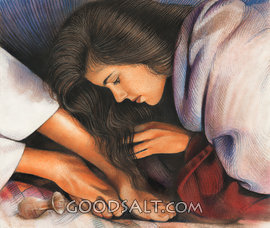
Luke 7:37-50
A Pharisee invited him to dine with him, and he entered the Pharisee's house and reclined at table.
Now there was a sinful woman in the city who learned that he was at table in the house of the Pharisee. Bringing an alabaster flask of ointment, she stood behind him at his feet weeping and began to bathe his feet with her tears. Then she wiped them with her hair, kissed them, and anointed them with the ointment.
When the Pharisee who had invited him saw this he said to himself, "If this man were a prophet, he would know who and what sort of woman this is who is touching him, that she is a sinner."
Jesus said to him in reply, "Simon, I have something to say to you." "Tell me, teacher," he said.
"Two people were in debt to a certain creditor; one owed five hundred days' wages and the other owed fifty.
Since they were unable to repay the debt, he forgave it for both. Which of them will love him more?"
Simon said in reply, "The one, I suppose, whose larger debt was forgiven." He said to him, "You have judged rightly."
Then he turned to the woman and said to Simon, "Do you see this woman? When I entered your house, you did not give me water for my feet, but she has bathed them with her tears and wiped them with her hair.
You did not give me a kiss, but she has not ceased kissing my feet since the time I entered.
You did not anoint my head with oil, but she anointed my feet with ointment.
So I tell you, her many sins have been forgiven; hence, she has shown great love. 13 But the one to whom little is forgiven, loves little."
He said to her, "Your sins are forgiven."
The others at table said to themselves, "Who is this who even forgives sins?"
But he said to the woman, "Your faith has saved you; go in peace."
This woman
- Is uninvited and also scorned, but she does not fear speaking
- She knows she has sinned
- She knows what she has done is wrong but she has hope
- She knows Jesus has given her forgiveness and a new life
- She knows she cannot make up for her sin but most importantly she knows the love of Jesus
- She knows (and is not surprised) by the realization that she is capable of any sin
- She is giving and has empathy towards others
- It is not about her anymore but about what He has done for her
Her focus is Christ centered.
The difference between them? The woman who was stoned did not know Jesus yet. The other knows Jesus has given her a new life, she is Christ centered, all she cares about is serving Jesus and letting others know what he has done for her.
Chances are, most of us are in the middle of the two, getting to know Jesus and beginning to trust.
Pope John Paul II tells those post abortive, in “The Gospel of Life,” that we should look at what happened and face it honestly; it was and always will be terribly wrong, but “do not give in to discouragement, do not loose hope”, but look at the many influences and to come to know the Father of Mercies and the wound in your heart can heal.
By acknowledging what we did, we are free to ask forgiveness from God, our children and ourselves. With humility comes trust in God and His promises, a little at a time. It is not about our feeling but about our will and actions. God understands if we are afraid. Trust in His love that saves and heals us. Trust in his love that drives out fear, shame and guilt and brings peace.
Humility acknowledges our dependence on him. Trusts Him with our lives. Humility allows us to surrender to Him knowing of His love for us and His desire to heal us. It is centering on Him instead of us. A knowing we cannot do it without Him. A struggle to be sure, a reconditioning of everything we have probably been doing, a fierce fight against what we have known and against our pride, but, you can begin right now. You can choose to trust despite your feelings. He will not let you down.
I would like to end with is a beautiful verse on humility:
“Humility is the fertile soil upon which the Divine Sower plants his seed”
May it flourish in our hearts.

 Reclaiming Our Children: A Blog About Healing After Abortion
Leave a comment